
'This is going to be an opportunity to hear from the prime minister of the new India and the progress made in the last two years of the growing cooperation between the US and India in several areas, including areas that would have seemed implausible a few years ago.' US Congressman Ed Royce, who led the campaign to have Prime Minister Modi address a joint session of Congress, speaks to Aziz Haniffa/Rediff.com in an exclusive interview.

Describing the Narendra Modi-led BJP's electoral victory as a "breathtaking landslide", eminent American think tanks and experts have said the win has given him an opportunity to "redefine" Indian politics.

'We are encouraged by what the prime minister said recently on these issues... We will keep a close eye on these issues. They are very important and as are other elements of our human rights and religious freedom.' 'So, absolutely, we'll keep a focus on them.'
'Both India and Pakistan are now, for the first time in history, very closely allied and connected with the US -- economically and politically.'

Following is the full text of Prime Minister Manmohan Singh's speech at the Central Party School in Beijing on Thursday:

'India and Indian Americans cannot rely on wishful thinking about the checks and balances in the US system to magically take care of the many dangerous things that Trump could do,' says Chicago-based writer Ram Kelkar.
'India is going to maintain its ties to China, India is going to develop a strong relationship with the United States. It means that India is going to have the flexibility to pick and choose its friends.' 'That's traditional Indian foreign policy, and it's smart.' Former US ambassador to India Frank Wisner, one of America's sharpest minds on South Asia, tells Aziz Haniffa/Rediff.com what Washington can expect from Narendra Modi's visit.
Natwar Singh's book is un-illuminating, largely self-justificatory, often contradictory, and at times tendentious. He is too preoccupied with depicting himself as a victim of the Congress party's machinations, says Praful Bidwai.

Top security experts of India and the US met in New Delhi on Wednesday to discuss various measures, including exchange of technologies, to help each other face challenges like terrorism, cyber crime and ensuring safety of major cities.

The spell that Prime Minister Narendra Modi cast over US lawmakers nearly two months during his visit to the United States has still not worn off, as was manifest by the gushing nostalgia of the Modi magic by both Democratic and Republican party representatives at the Congressional Diwali celebration on Capitol Hill on Wednesday.
.jpg)
Mayank Ashar talks about India's business environment.

'It is in the interest of both sides that the visit of the US President is seen as being successful. Both sides have invested considerable political capital in it. This rapid exchange of visits and the decisions taken have to be justified, beyond the symbolism, which is no doubt important in itself. This opportunity to impart a fresh momentum to ties should not be missed,' says former foreign secretary Kanwal Sibal.

A secret document provided by National Security Agency whistleblower Edward Snowden reveals that only 1 billion of the 1.35 intercepts that the US snooped on are terror related, the rest a breach of privacy. Vicky Nanjappa reports

'India was in no position to wage another war in 1965, having suffered a morale-shattering defeat in 1962. The three services were in the middle of a modernisation and expansion phase and therefore not fully trained or battle-ready.'

15 per cent of startups in Silicon Valley are founded by Indians.

With Sundar Pichai becoming the CEO of Google, India has one more reason to cheer its prowess in the global IT sector.
'Modi has said he has been made the PM of India not to do small things but big things. What bigger thing can there be than to have peace with Pakistan and in the neighbourhood?'
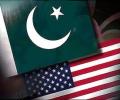
US Assistant Secretary of State for South and Central Asia Nisha Desai Biswal believes the India-US nuclear deal is not in limbo and it is for India and Pakistan to set the pace for conversations to resolve their issues. Rediff.com's Aziz Haniffa reports from Washington, DC.

Tripura's popular chief minister shows up the failures of the elitist central leadership of India's Left, says Devesh Kapur

The city readies itself for the biggest economic, political and social event of the year

'They don't always agree with our governments, their teachers or their parents, but it is the conviction of their ideas, and their determination to share them with the world that, I believe, is one of the greatest sources of hope for our planet.' 'The colonisation of space, understanding the very building blocks of matter and the universe, utilising our understanding of the human genome to conquer disease -- these are the tasks waiting for a fellowship of minds to realise new triumphs in our collective destiny.'
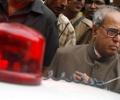
Coming down heavily on Pakistan, President Pranab Mukherjee has said unless it dismantles the terror infrastructure on its soil, there is no scope for progress in talks between the two countries.
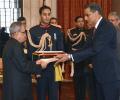
'India is part of our strategic and economic future,' says Richard Rahul Verma, the first Indian American to be appointed US Ambassador to India.

A lot of the terrorism that is affecting Pakistan is really a blowback of the Pakistani state's policy of using jihadist groups as instruments of state policy. And unlike some other countries with similar policies, Pakistan doesn't have the benefit of the political and social space for pulling back from the disastrous course, says Sushant Sareen.
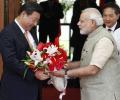
Arvind Subramanian talks about US and China's power play and where India figures in these dynamics.
 © 2026 Rediff.com - Advertise with us - Disclaimer - Privacy Policy - Sitemap - Feedback - About us - Terms of use - Grievances